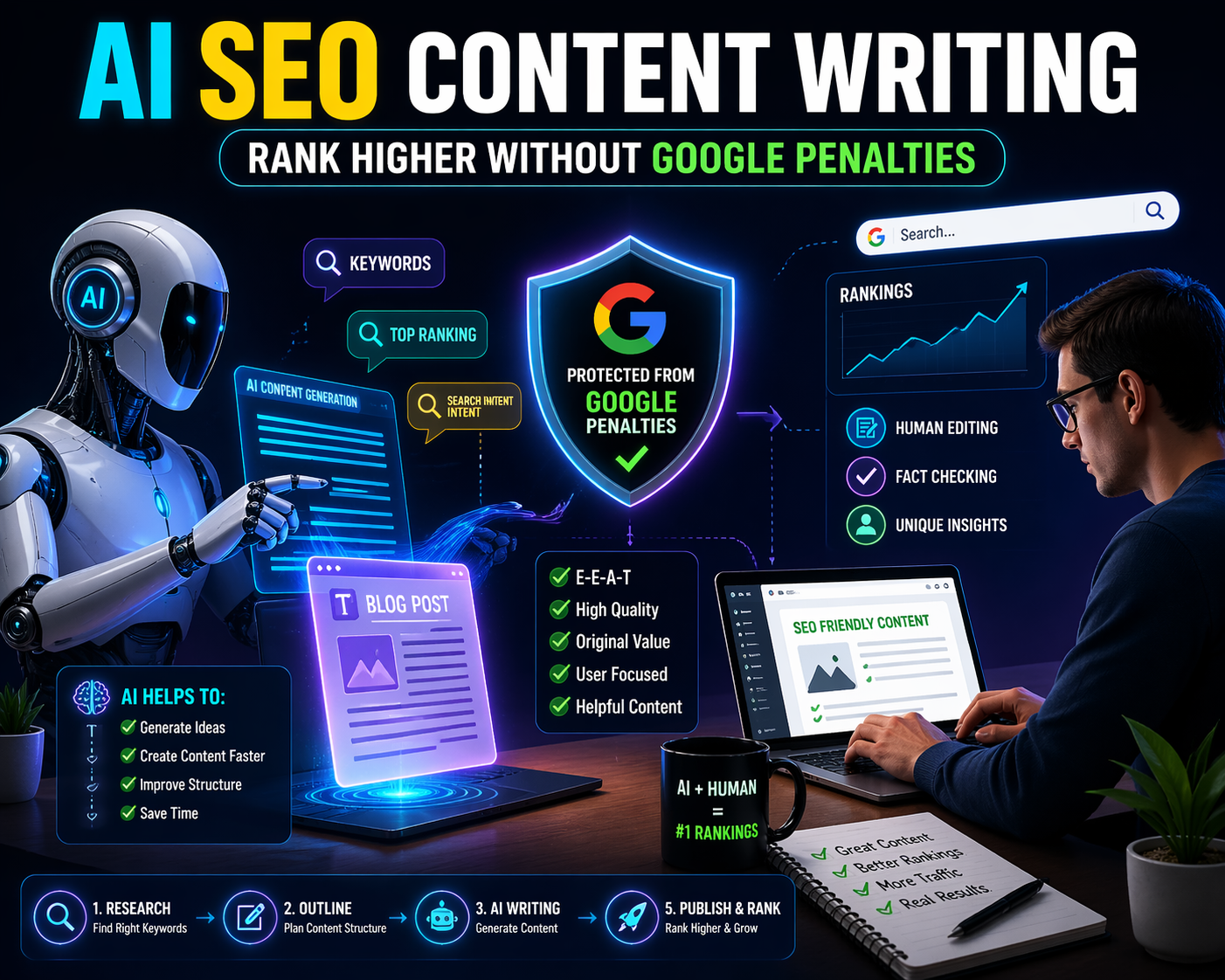
AI SEO Content Writing: Rank Higher Without Google Penalties

Artificial intelligence has completely transformed how content is created. What once took days can now be done in minutes. But speed alone isn’t enough low-quality AI content can hurt your rankings if it lacks human insight and real value.
That’s why smart creators use AI as an assistant, not a replacement. Tools like Nanoseotools help streamline workflows, but success depends on how you guide, edit, and optimize the output.
This guide will show you how to create high-quality, SEO-friendly AI content that ranks well, engages readers, and stays safe from Google penalties.
Common Mistakes That Get AI Content Penalized
Before improving, you need to know what to avoid. Most AI content fails due to these common issues:
1. Publishing Raw AI Content
Directly publishing AI-generated text without editing is a major mistake. It often:
- Feels generic
- Lacks depth
- Contains inaccuracies
Google prioritizes helpful, human-first content, not auto-generated text.
2. Ignoring Search Intent
If your content doesn’t match what users actually want, it won’t rank.
Example:
“Best running shoes” → users expect recommendations, not history.
Always analyze top-ranking pages before writing.
3. Keyword Stuffing
Overusing keywords makes content unnatural and spammy.
Instead:
- Use keywords naturally
- Focus on topic coverage
- Write for humans first
4. Not Fact-Checking
AI can generate incorrect or outdated information.
Always verify:
- Statistics
- Claims
- Sources
This protects your site’s E-E-A-T (trust and authority).
5. No Original Value
AI cannot replace:
- Personal experience
- Case studies
- Unique insights
Without these, your content won’t stand out.
Step-by-Step Workflow for Writing SEO Content with AI
Step 1: Understand User Intent
Identify what the user wants:
- TOFU: Informational (e.g., “What is SEO”)
- MOFU: Comparison (e.g., “Best SEO tools”)
- BOFU: Purchase (e.g., “Buy SEO tools”)
Your content must match this intent.
Step 2: Do Smart Keyword Research
Find:
- Primary keyword
- Long-tail keywords
- Related search terms
AI can assist, but tools (like those available on Nanoseotools) help validate real search demand.
Step 3: Create a Strong Outline
Analyze top-ranking pages and build:
- Clear headings (H1, H2, H3)
- Logical structure
- Complete topic coverage
Step 4: Generate AI Content with Smart Prompts
Give AI clear instructions:
- Target audience
- Tone (professional, friendly, etc.)
- Content type (guide, list, etc.)
Better prompts = better output.
Step 5: Optimize On-Page SEO
Focus on these elements:
- Title Tag → include keyword
- Meta Description → engaging + keyword
- URL → short and clean
- Headings → structured and optimized
- Internal Links → connect related pages
- Alt Text → describe images
Step 6: Add Human Expertise
This step prevents penalties.
Add:
- Real examples
- Personal insights
- Verified data
This is what makes content rank.
Step 7: Publish with Technical SEO
Before publishing:
- Check mobile responsiveness
- Ensure fast loading speed
- Fix broken links
- Validate schema
Step 8: Monitor and Improve
Track:
- Rankings
- Traffic
- Engagement
Update content regularly to maintain performance.
How to Make AI Content High Quality
Improve Brand Voice
Edit AI text so it sounds like your brand, not generic content.
Add Unique Value
Include:
- Case studies
- Real data
- Personal experience
This builds authority.
Use Active Voice
Example:
- ❌ Passive: “Content was written…”
- ✅ Active: “We wrote this content…”
Active voice improves readability.
Improve Readability
- Keep paragraphs short
- Use bullet points
- Add subheadings
- Highlight key points
Optimize for AI Search (Future SEO)
Modern SEO includes AI results.
To optimize:
- Answer questions clearly
- Use simple language
- Add FAQ sections
Quick SEO Checklist
Technical
- Proper headings
- Working links
- Meta description optimized
- Images with alt text
Content
- Unique insights
- Fact-checked data
- Engaging writing
- Clear structure
Why Use AI Tools Like Nanoseotools?
Platforms like Nanoseotools help you:
- Generate content faster
- Optimize keywords
- Improve structure
- Save time
But remember AI helps, humans finalize.
Conclusion
Writing SEO content with AI without getting penalized comes down to one rule:
👉 AI creates, humans refine.
Use AI for:
- Drafts
- Ideas
- Structure
Then improve it with:
- Experience
- Accuracy
- Original insights
When done right, AI + human expertise creates content that:
- Ranks higher
- Builds trust
- Drives real results